
Checking Criminal History in Osceola County
Begin with the event, not a broad name search. The place, date, and type of contact point to the right custodian. An incident inside Reed City or Evart can produce a city police report. A sheriff response produces a county record. The 77th District Court holds misdemeanors and the first stages of felonies, while a felony bound over for trial moves to the 49th Circuit Court. The Michigan State Police Criminal Justice Information Center receives public reportable criminal-history events after agencies, prosecutors, and courts submit them.
Use a full legal name, date of birth, prior names, an approximate year, and a case or incident number when one is known. A matching name alone is weak proof. Confirm the county, court, birth data, and disposition with the office that made the record. Osceola County records can also be confused with results from Florida, Iowa, or nearby Oceana County, so the official Michigan domain and office address matter.
- Identify whether the needed item is a police report, booking record, court file, repository result, warrant check, or supervision record.
- Search the correct court in MiCOURT Case Search when the question concerns charges, hearings, or an outcome.
- Use the Internet Criminal History Access Tool for a public name-based Michigan repository search.
- Call or visit the sheriff for current jail custody, sheriff reports, or focused booking requests that are not available through a verified county roster.
- Obtain the source court document or agency report before relying on a result, and use a certified copy when official proof is needed.
Four Osceola County Record Systems
Four official routes answer four different questions. The Osceola County jail phone and a focused Freedom of Information Act request address present custody or local booking material. MiCOURT shows public case events for participating courts. ICHAT shows public reportable Michigan history held by the state repository. The Michigan Department of Corrections Offender Tracking Information System, or OTIS, covers current MDOC prisoners, probationers, and parolees plus people discharged within the prior three years.
| Channel | Best question | Main limit |
|---|---|---|
| Sheriff and jail | Is someone in local custody, or does a sheriff report exist? | No verified public online Osceola County roster |
| MiCOURT | What occurred in a participating criminal court case? | Coverage and shown fields vary by court |
| ICHAT | What public reportable Michigan history is in CJIC? | No warrants, federal, tribal, juvenile, or out-of-state records |
| OTIS | Is a person under recent MDOC custody or supervision? | Not a full lifetime criminal history |
The comparison keeps a blank result in context. It can mean the wrong system was searched, the record is outside the product's scope, or the event has not yet reached that system.
Michigan Official Background Checks
The Michigan State Police criminal-history service explains both public name checks and fingerprint routes. ICHAT requires first name, last name, gender, race, and date of birth. An ordinary search costs $10. It can return public Michigan felony arrests and convictions and qualifying misdemeanor convictions, but it omits suppressed entries, warrants, traffic records, juvenile records, federal and tribal matters, local misdemeanors, and records from other states.
A person reviewing their own complete Michigan record follows the MSP fingerprint-card route. A Michigan resident obtains an RI-008 card from law enforcement, mails it with the required cover information and a $30 payment to CJIC, and receives the fingerprint-matched response. MSP publishes a three-to-five-week processing and mail estimate. A statutory Live Scan check uses form RI-030 supplied by the requesting or licensing agency. Its total varies because state, FBI, and vendor charges depend on the authorized purpose.
The MSP criminal-history overview is pictured below as the state entry point.
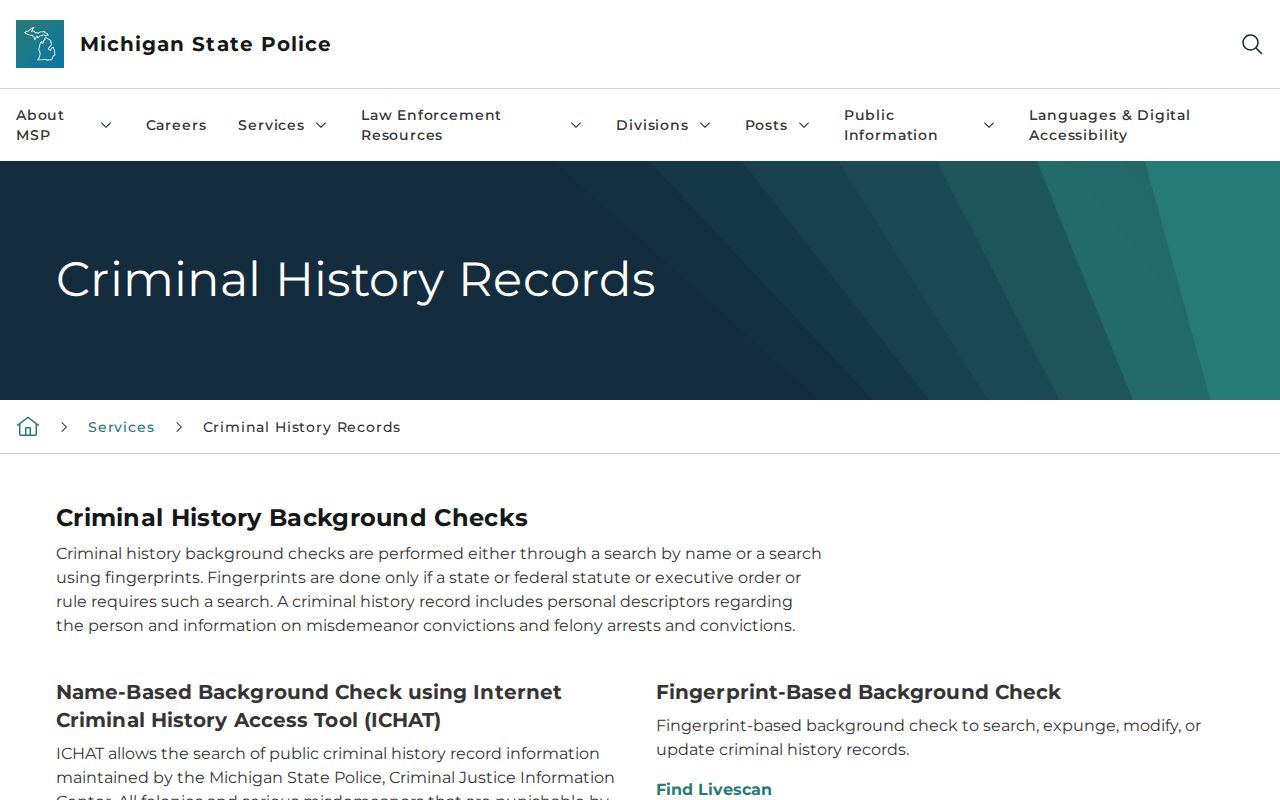
That state page separates ICHAT, fingerprint review, corrections, and set-aside resources so a reader can choose a lawful product by purpose.
| Official product | Method | Published cost |
|---|---|---|
| ICHAT public search | Name and personal descriptors | $10 ordinary search |
| Own Michigan record review | RI-008 fingerprint card by mail | $30, plus $1 for each extra original |
| FBI Identity History Summary | Fingerprints through the FBI electronic request portal | $18 FBI fee, plus an optional channeler cost |
| Statutory Live Scan | RI-030 and approved capture site | Purpose and vendor dependent |
Osceola County ICHAT Record Gaps
ICHAT is a repository summary, not a copy of the police report or court file. A prosecutor may change an arrest charge before filing. A court may later dismiss a count, accept a plea to another count, or correct a disposition. Reporting delay, an alias, and a data-entry mismatch can also make the state result differ from the source docket. Those gaps are why an Osceola County criminal record should be traced back to the court and arresting agency.
For the state forms used to challenge or update a record, consult the Michigan State Police forms library.
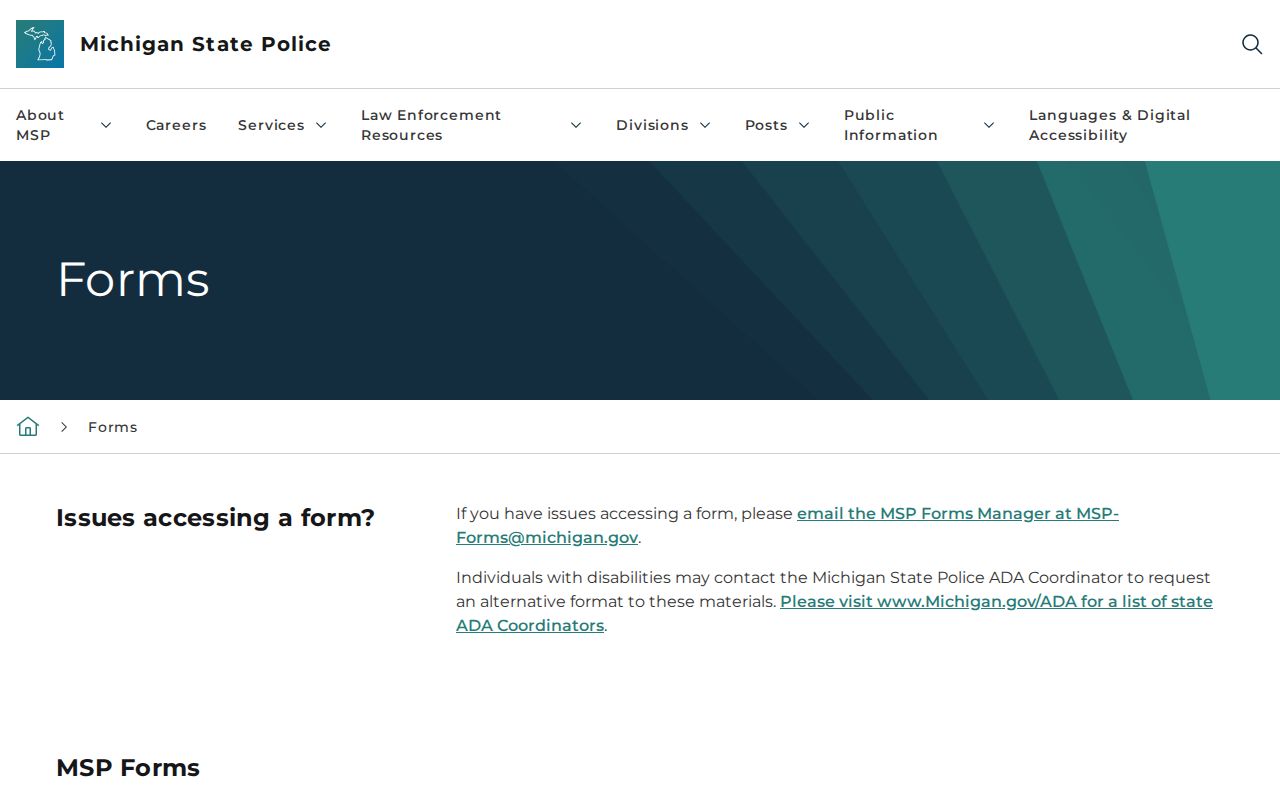
The forms page includes RI-026 for an ICHAT challenge and RI-030 for an authorized Live Scan request, each serving a different record task.
If the disputed item is a court disposition, first obtain the certified judgment from the sentencing court. The court should send the correction electronically. RI-027 is available when the court cannot update it that way. Keep the ICHAT transaction details, state exactly which item is wrong, and attach the source document rather than relying on a verbal account.
Criminal Record Types
An Osceola County criminal record can describe an allegation, a custody event, a court action, or a later state summary. The sheriff or police agency writes an incident or arrest report. The jail records intake and release. The court records what prosecutors filed and how the judge resolved the case. CJIC compiles reportable events, while MDOC and PSOR publish narrower records tied to corrections or registration.
- Incident and arrest report: the investigating agency's narrative, evidence references, probable cause, and initial allegations.
- Booking record: the sheriff's custody intake, charge labels, bond, dates, and release status where releasable.
- Court case file: complaints, motions, hearings, pleas, trial results, orders, sentence, and financial entries.
- ICHAT record: a public statewide compilation of reportable Michigan events, subject to statutory limits.
- Warrant, OTIS, and PSOR records: distinct products for judicial commands, MDOC supervision, or public registration duties.
The Osceola County government directory shows the local departments that keep many of these source records.
The county directory is a sound starting point when a record needs a clerk, sheriff, prosecutor, or community corrections contact rather than a database.
Osceola County Police Record Custodians
Agency boundaries decide where a police record stays. Reed City Police and Evart Police retain the incident and arrest reports their officers create. The Osceola County Sheriff holds sheriff reports and jail booking material. A Michigan State Police investigation goes through the MSP public-records channel, while a conservation case may require the Michigan Department of Natural Resources. Sending one broad county request will not collect records that exist only in a city or state office.
Look at the citation, incident number, officer agency, dispatch information, or court complaint to identify the creator. Then describe the event, date, location, record type, and desired format in a focused request. This step matters across rural Osceola County, where a mailing address or place name may not show which agency responded. It also prevents a Reed City label from being treated as conclusive when parts of the community cross the Osceola and Lake county line.
Osceola County Jail Record Fallbacks
No verified official online inmate search or jail roster was found for Osceola County, Michigan. The practical route is direct. Call the Sheriff and jail at 231-832-2288 for current custody, visit 325 W. Upton Avenue in Reed City, or submit a focused Michigan FOIA request for releasable older booking material. Search results for a same-name sheriff in Sibley, Iowa are not an Osceola County, Michigan source.
A request should name the record type and give the incident number, approximate date, location, involved name, and a narrow date range when available. Michigan FOIA asks an office to locate an existing public record. It does not require staff to answer broad questions or create a new compilation. A public body generally responds within five business days and may extend the response period by up to ten business days. Production can take longer for a large or heavily redacted request.
Osceola County Sheriff
325 W. Upton Avenue
Reed City, MI 49677
231-832-2288
Public lobby: 9:00 a.m. to 4:00 p.m.
County Courts and Clerk
301 W. Upton Avenue
Reed City, MI 49677
District, circuit, and circuit-clerk records
Note: Express Account and ICSolutions provide inmate services, but neither is an official Osceola County inmate name search.
Inside an Osceola County Criminal Record
A record's field labels show where it sits in the process. Personal descriptors help distinguish people with similar names. The arrest cycle names the agency and the initial charge. The prosecutor's filed count may differ. The register of actions then tracks hearings, motions, pleas, trial events, judgment, and sentence. Read each field with its source and date in mind.
| Name and identifiers | Legal name, aliases, date of birth, sex, race, and state identifiers when lawfully shown |
|---|---|
| Arrest data | Arrest date, agency, fingerprint transaction, and the charge recorded at that stage |
| Court charges | Offense description, statute, original or amended counts, and offense level |
| Disposition | Dismissal, plea, verdict, deferral, or another final court result |
| Sentence | Custody, probation, fines, costs, restitution, and later public supervision events |
| Current status | Open or closed case status, custody, parole, probation, or discharge when the source provides it |
A dismissal is not a conviction. An open status is not a final result. The court docket may contain later action that has not yet reached ICHAT, and a screen print is not the same as a certified court copy.
Osceola County Warrant Record Chain
Osceola County has no verified public active-warrant database, and ICHAT expressly omits warrants. Contact the Sheriff for sheriff-held information. Ask the 77th District Court about district or bench warrant events, and ask the 49th Circuit Court about circuit felony warrant events. MiCOURT may display a register entry, but it is not promoted as a live warrant-clearance system.
When a possible warrant concerns the reader, counsel can confirm it with the issuing court before a surrender or appearance is arranged. Sealed and juvenile warrant matters will not be public. A payment, recall, quashing, or court appearance may not update every system at once. Final confirmation should come from the court that issued the command, not a cached search result.
Note: A bench warrant often follows nonappearance or noncompliance, while an arrest warrant rests on a judicial probable-cause finding.
Public Access Laws in Michigan
Michigan law separates executive-agency records from court records. Police and sheriff reports are requested under the Michigan Freedom of Information Act, subject to privacy, investigation, safety, and other exemptions. Court dockets and files are accessed through judicial rules and clerk procedures. An exemption applies to the protected material, so releasable parts may be separated from withheld details.
Key Michigan laws:
MCL 15.231 to 15.246 sets the FOIA right, response rules, fees, and exemptions.
MCL 28.241a governs criminal-history record dissemination.
MCL 780.621 establishes application-based conviction set-aside relief.
MCL 780.621g provides Michigan's automatic set-aside framework.
MCL 28.721 and following govern sex-offender registration and public registry access.
A lawful public view can omit sealed files, juvenile matters, victim details, personal identifiers, and active investigative content. Absence from a public product is not proof that no restricted source record exists.
Osceola County Supervision Records
Felony probation and parole in Osceola County are supervised through MDOC Field Operations. The Osceola County Parole and Probation Office is at 301 W. Upton Avenue in Reed City, with a published phone of 231-832-6162. The 77th District Court is the route for local misdemeanor probation records. Court orders and violation entries remain part of the sentencing docket, while OTIS supplies current or recent MDOC status.
Community Corrections is related to local programming but is not the same custodian as MDOC. Its county office lists 301 W. Upton Avenue and 231-832-6163. The Osceola Community Corrections page identifies that local program.
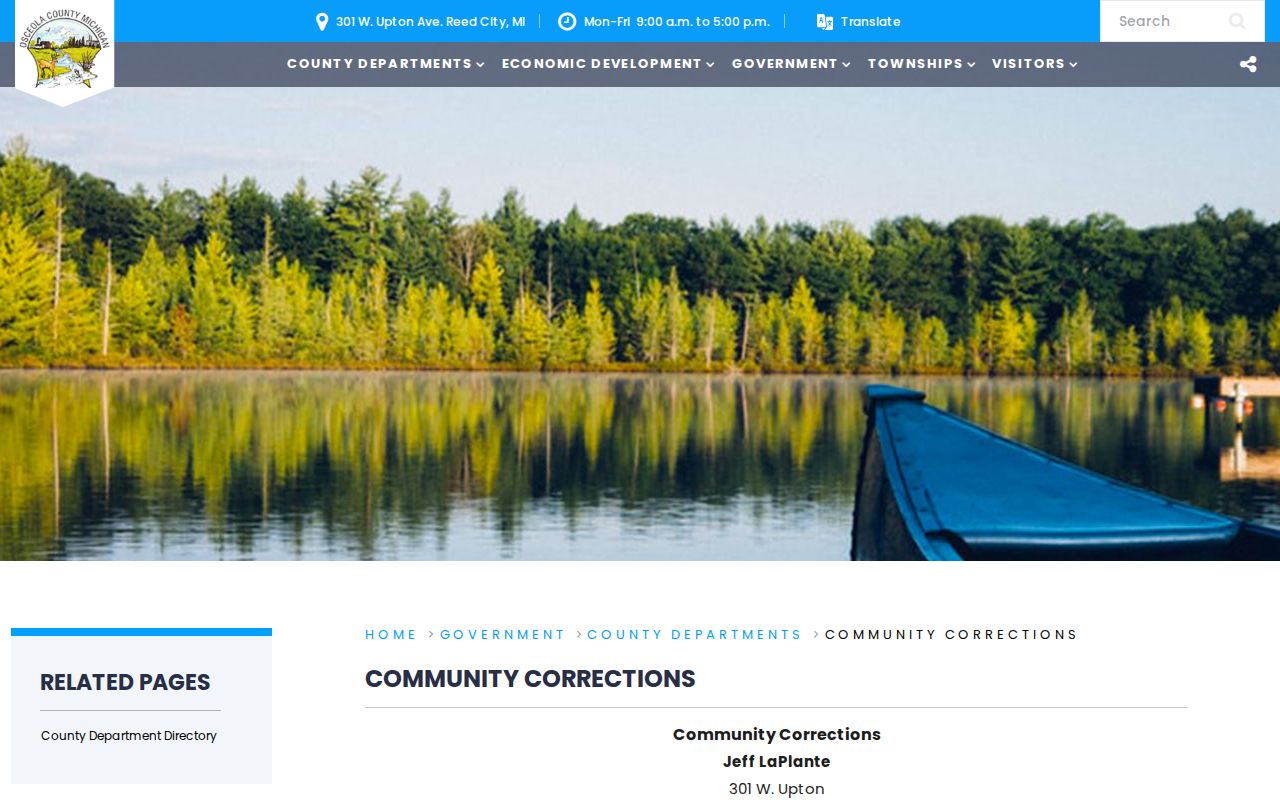
The county program page helps distinguish local community corrections contact from the MDOC field office that supervises felony probation and parole.
- Probation
- Court-ordered community supervision, with the supervising body tied to the offense and court.
- Parole
- Community supervision after a prison term under MDOC and Michigan Parole Board authority.
- OTIS
- The MDOC public locator for current and recent custody or supervision, not a full rap sheet.
Sealed, Expunged, and Restricted Records
Michigan uses the term “set aside” for relief commonly called expungement. Application relief under MCL 780.621 depends on the offense, count limits, waiting periods, pending charges, and exclusions. Automatic Clean Slate relief under MCL 780.621g applies to qualifying convictions after statutory periods. It began operating in 2023, but excluded cases and incomplete data can delay or prevent a match.
For an application, obtain a certified conviction from the 77th District Court or 49th Circuit Court, use the current State Court Administrative Office forms, obtain the required fingerprints, and serve the parties identified by the form. The MSP processing payment is $50. That amount is not a verified Osceola County clerk fee. After an order, allow the agencies time to update, then recheck the public docket and ICHAT.
The official MSP record review and correction route is the source shown below.
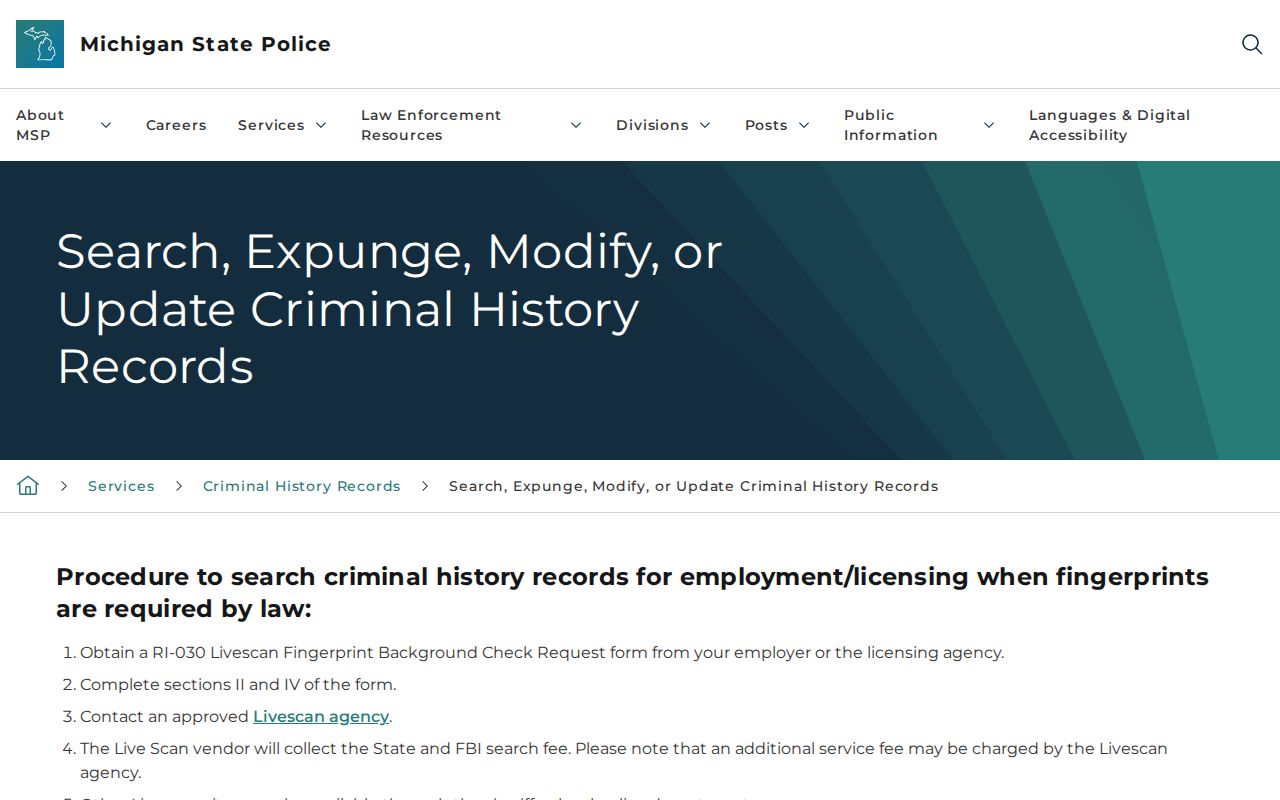
That page connects fingerprint self-review, record correction, and current set-aside information without treating a public name search as a full personal record.
Federal Osceola County Criminal Records
Federal cases do not appear in MiCOURT or ICHAT. Osceola County lies in the Southern Division of the U.S. District Court for the Western District of Michigan. PACER provides federal dockets after registration and publishes a rate of $0.10 per page through 2026, capped at $3 for most individual documents. Charges of $30 or less in a quarterly billing cycle are waived. Sealed filings and protected identifiers remain unavailable.
The Western District of Michigan court site is the official federal court entry pictured below.
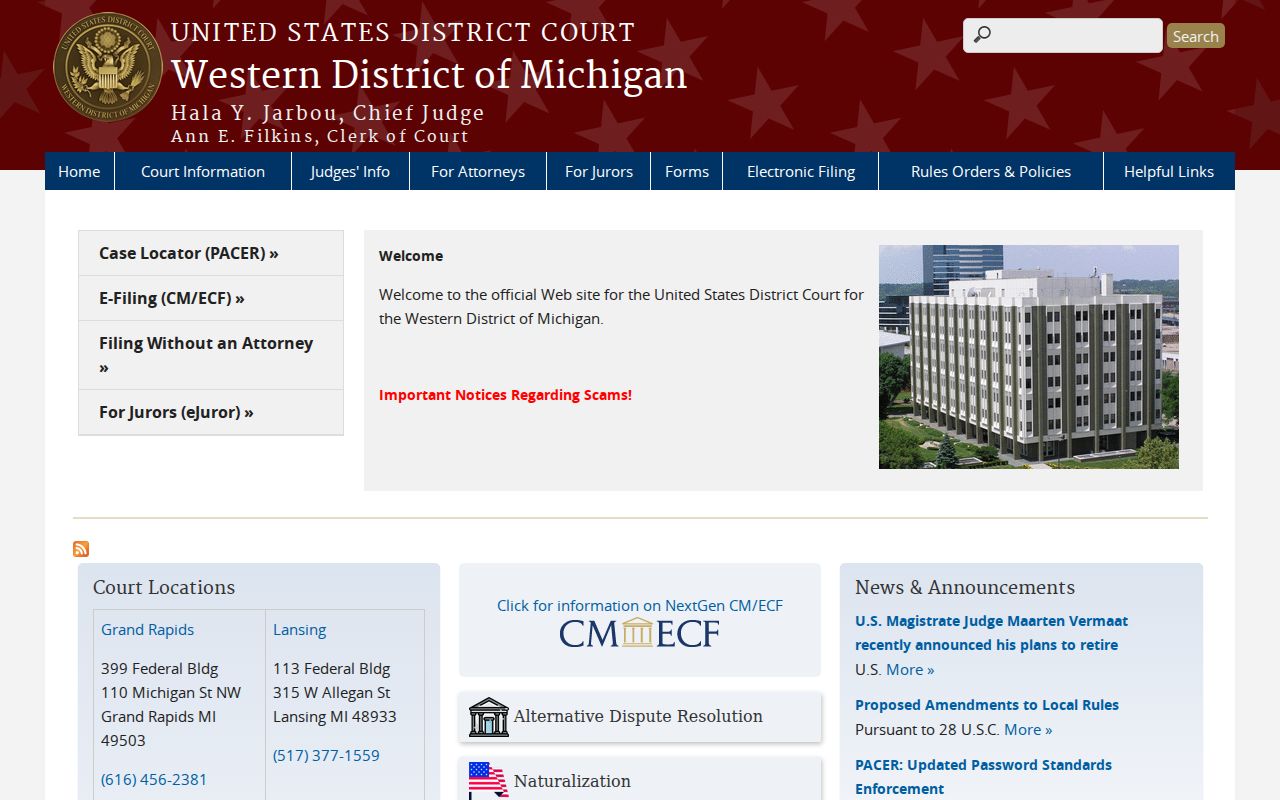
The federal site and PACER form a separate docket layer, while the Bureau of Prisons locator covers federal custody rather than county jail or MDOC status.
Osceola County Criminal Records by City
The three largest incorporated places are Reed City, Evart, and the Village of Marion. Local record custody differs. Reed City and Evart police reports stay with their city agencies, even when the jail and criminal docket are county systems. Marion has no verified local police department or municipal court, so a search begins by identifying whether the Sheriff or Michigan State Police responded.
Reed City Criminal Records
Population 2,531. City reports use city FOIA, while cases and jail custody route through Osceola County.
Evart Criminal Records
Population 1,782. Evart Police keeps city reports, and criminal cases move through the county courts.
Marion Criminal Records
Population 798. Marion is a village, so identify the responding county or state agency first.
Reed City is also the county seat and records hub. That location does not make a city police file a county record. Send each request to the office that created the item.