
Checking Criminal History in Marion
Do not start a Marion search by assuming a Marion village office holds the police file. Read the incident number, agency name, officer badge line, citation, booking paperwork, or dispatch information. Those Marion details determine whether the Osceola County Sheriff or Michigan State Police is the proper report custodian. Then trace Marion custody and court proceedings through their separate county channels.
- Identify the responding agency from the Marion-area paperwork or by asking dispatch which agency handled the incident location and date.
- Request the incident or arrest report from that agency, using its own FOIA channel and a narrow record description.
- Contact the Osceola County Sheriff or jail by phone, in person, or FOIA for booking and current-custody information.
- Search the 77th District Court in MiCOURT, then search 49th Circuit if a felony may have moved after bindover.
- Use ICHAT for public reportable Michigan history after checking the Marion-area source report and official court result.
When searching a name, confirm the venue, case number, filing year, public age or birth details, and charge. Marion is the place involved, but the agency and court identifiers establish where the record actually belongs.
Marion Village Status Shapes Record Access
Marion is a village, not a city. The official July 1, 2024 Census estimate lists the Village of Marion with 798 residents, making Marion the third-largest incorporated place in Osceola County. That Marion status earns the village a local records profile, but it does not create a police department or court that research could not verify.
The official Census incorporated-place reference confirms the governmental place classification used for Marion.
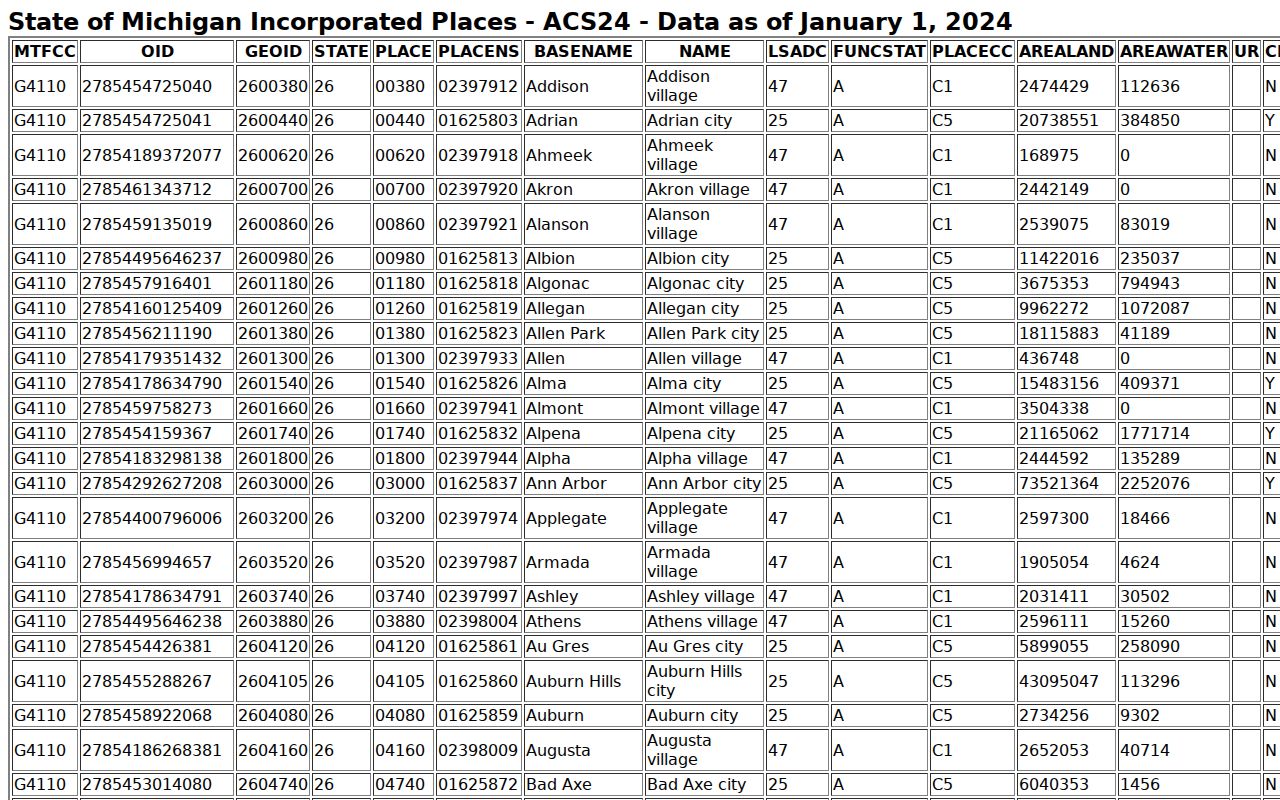
The village classification is practical search information: it warns readers not to direct a report request to a made-up Marion city police records unit.
Marion Police Department Records
No official Marion police department, police records portal, local arrest blotter, report form, police app, or municipal website was verified. A Marion-area report must be requested from the agency that responded. Marion research identifies the Osceola County Sheriff and Michigan State Police as common possibilities where no village agency created the record, but the Marion incident location alone does not prove which one handled it.
If the Osceola County Sheriff's Office responded in Marion, describe the existing report by date, location, involved party, type, and incident number if known. If a state trooper responded in Marion, use the official MSP records and FOIA channel. Do not send the same vague request to several offices and assume they share one file system.
A Marion address can lie near jurisdictional boundaries or involve mutual aid. The agency line on a citation or report is stronger evidence than a postal place name. When no paperwork is available, ask dispatch to identify the responding agency before filing the record request.
Sheriff or MSP for Marion Records
The choice between Sheriff and MSP controls access to the narrative. The Osceola County Sheriff is the local source for sheriff-created incident reports and county jail records. MSP has its own public-records process for state-police reports. Neither office is required to produce a record maintained only by the other.
| Clue | Likely Marion route |
|---|---|
| Osceola County Sheriff named on paperwork | Request the incident record from the Sheriff and booking from the county jail. |
| Michigan State Police trooper or post named | Use the MSP FOIA channel for the agency report. |
| County jail intake document | Ask the Sheriff or jail for the booking entry, not MSP. |
| Court case number | Use MiCOURT and the assigned district or circuit clerk. |
The official Michigan State Police public-records page is the correct state channel when a trooper created the Marion-area report.
The MSP route does not replace the county jail or court clerk. It supplies the state-police agency record for the event it handled.
Marion Arrests and Bookings
A Marion-area arrest report and Marion booking are separate. The responding Sheriff deputy or state trooper creates the agency record. If the person enters the Osceola County jail after a Marion arrest, the Sheriff creates the intake and custody entry. No verified official online Osceola County roster or weekly booking PDF was located, so current Marion information requires phone, in-person, or FOIA contact with the Sheriff or jail.
Ask for the booking date, custody status, bond, release information, and the process for obtaining the entry. A jail charge label reflects the custody event and may differ from what a prosecutor later files. The absence of a current custody confirmation does not establish that no earlier Marion arrest occurred.
The court record may appear after the agency and jail records because prosecutors must review and file charges. A very recent event can therefore be known to the responding agency and jail before it is searchable in MiCOURT.
A Marion Address Hides the Custodian
Mailing geography and law-enforcement jurisdiction are not the same. A “Marion” mailing address may not establish that an event happened within village limits, and village limits do not identify whether the Sheriff or MSP responded. Use the exact incident location and agency documentation before choosing the records channel.
Practical rule: Follow the badge and agency line first, then use the Marion address to narrow the requested incident.
This step prevents a common rural-record error: asking a nearby local office for a record it never created. It also helps a request meet FOIA's requirement to describe an existing public record with enough detail for staff to find it.
Municipal Court Records in Marion
There is no verified Marion municipal court. Misdemeanors and preliminary felony proceedings route through the 77th District Court. A felony that survives preliminary examination or waiver moves to the 49th Circuit Court. The courts serve Marion through Osceola County and are located in Reed City, so a search for a fictional Marion village court would miss the proper docket.
| Court Name | 77th District Court; 49th Circuit Court for a felony after bindover. |
|---|---|
| Case Types Heard | District misdemeanors and early felony events; circuit felony proceedings after bindover. |
| Case Lookup Channel | MiCOURT Case Search, followed by the assigned Osceola court clerk for the official file. |
| What the Docket Shows | Filed charges, hearing entries, case status, orders, disposition, sentence, and later action. |
| Copies & Fees | Contact the clerk for current copy and certification charges; no reliable local schedule was found. |
The 49th Circuit is shared with Mecosta County. A circuit number alone does not prove that a Marion-related filing belongs to Osceola County, so confirm the venue displayed in the result.
Why Marion Records May Use Two Courts
A felony can leave a trail in both trial courts. The 77th District Court holds arraignment and preliminary events. After bindover, the 49th Circuit Court becomes the felony trial-level court. Search both when the case stage is unknown, and keep each case number because the district and circuit entries may not use the same identifier.
MiCOURT requires court selection and can expose case-number or party-name modes depending on the selected court. Marion name fields, a date-of-birth field where available, and filing-year filters can narrow results. Participation and displayed fields vary, and the court advises users to contact the court for the official Marion record.
| MiCOURT control | Use for Marion records |
|---|---|
| Court selection | Select 77th District first and 49th Circuit when a Marion felony may have moved. |
| Case Search or Name Search | Use the mode supported by the selected participating court. |
| Case number | Enter the district or circuit number in the format that court shows. |
| Party first and last name | Compare identifiers before assigning the Marion result to a person. |
| Date of birth or filing year | Use an exposed filter to narrow common-name or older results. |
The official Michigan trial-court directory identifies the proper court structure instead of a nonexistent Marion municipal forum.
The directory helps route a Marion clerk request when MiCOURT names an entry but does not provide the document itself. The official 77th District Court and 49th Circuit Court pages identify the county offices that replace any assumed Marion court.
Where Marion Records Go
The responding agency creates the Marion-area incident or arrest report. The county jail separately records custody. The prosecutor and court add charging and disposition events, and qualifying data can be reported to Michigan State Police CJIC. Because Marion has no verified local police repository, the first box in the chain depends on the actual responder.
Record flow: Responding Sheriff or Michigan State Police › Osceola County Courts › Michigan State Police Criminal Justice Information Center
Recent Marion activity belongs at the source agency and jail. A later ICHAT result is a public statewide summary, not the report or court file. ICHAT omits warrants, federal and tribal records, traffic, juveniles, suppressed records, other states, and purely local misdemeanors.
Reading Marion Criminal Record Results
Keep the arrest charge, filed charge, and disposition separate. A responding officer records suspected conduct. A prosecutor may add, reduce, amend, or decline a charge. The court later records whether the case remains open and how it ended. An arrest or booking is not proof of guilt.
- Agency report
- The Sheriff or MSP narrative and associated investigative material for the Marion-area event.
- Booking record
- The county jail intake and custody entry, separate from the police narrative.
- Court docket
- The filed case and dated register of actions in district or circuit court.
- ICHAT entry
- The public reportable Michigan repository view, which may be narrower or delayed.
When the state entry appears wrong, obtain a certified disposition from the sentencing court. Courts correct their disposition data, while MSP form RI-026 supports a public ICHAT challenge with the specific transaction and official documentation.
When Marion Custody Moves to OTIS
The county jail answers recent Marion custody. Michigan Department of Corrections OTIS answers a different question: who is or recently was in qualifying state prison, parole, or probation status. A person sentenced from a Marion-related felony may later appear in OTIS after leaving the Marion county-jail stage.
Absence from the jail does not establish absence from MDOC supervision, and absence from OTIS does not prove there was no Marion arrest or misdemeanor case. Use the unique MDOC number when known because OTIS name searching is spelling-sensitive. Treat the locator as a custody or supervision tool, not a complete criminal history.
Public Access Rules in Marion
Michigan FOIA applies to executive-agency records held by the Sheriff or MSP, not to an invented Marion police office. A request should describe an existing record. The public body generally responds within five business days and can grant, deny, grant in part, issue a deposit notice, or extend the response period by up to ten business days. Production can take longer for a large request.
Key Statutes:
Michigan Freedom of Information Act, MCL 15.231-15.246 governs access, fees, response steps, and exemptions for executive records.
MCL 15.243 lists exemptions that can protect privacy, investigations, sources, methods, and safety.
MCL 28.241a controls dissemination of Michigan criminal-history information.
Court files are accessed under judiciary rules and clerk procedures. Juvenile records, sealed or set-aside matters, protected victim information, and personal identifiers can be absent or redacted. A lawful public view is not proof that no restricted record exists.
Confirming Marion Criminal Records
A complete Marion inquiry is a chain, not one name search. Confirm the responder, request the agency report, ask the county jail about custody, and read both courts when a felony stage is unclear. Then compare any ICHAT entry with the certified disposition rather than assuming the state summary contains every local detail.
If no result appears, recheck agency identity, spelling, court selection, venue, and timing. The record may be too new, held by the other agency, moved to circuit court, or lawfully restricted. That careful route respects Marion's actual village structure and avoids inventing an office that does not exist.